
When the Auction Stops Clearing
Southeast Asian private equity realised about a third less from its exits in 2025, and several of the sponsors who spoke at September's Asia PE-VC Summit said that appointing a bank and running a process no longer reliably produces a sale. The exit that does not happen is not cancelled. It is converted into a partial sale, a refinancing, a continuation vehicle or a longer hold, and each of these moves risk onto a lender, a management team or a limited partner who did not underwrite it.
October 2026 | Monthly Insights
The Exit Gap
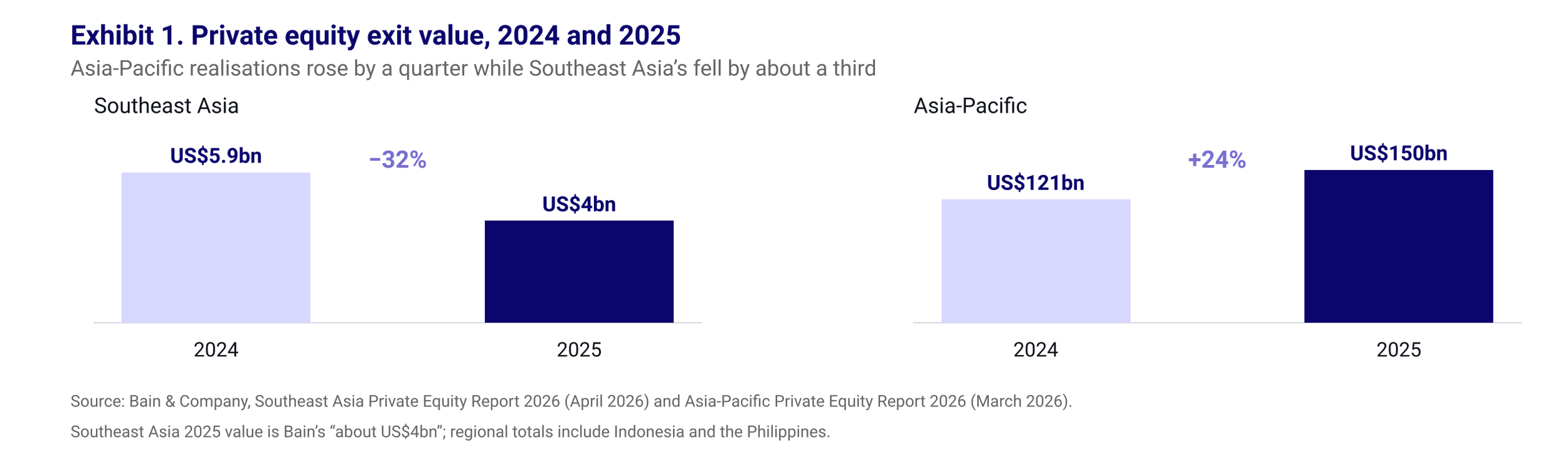
Bain puts Southeast Asian private equity exit value at about US$4bn in 2025, down 32% from US$5.9bn, with trade sales the dominant route. Over the same year exit value across Asia-Pacific rose 24%, on listings in Greater China, India and Korea, and the stock of companies held for more than five years grew 18%. Southeast Asia did not take part in the recovery.
The one channel that grew was the one in which a sponsor sells to another sponsor. DealStreetAsia counted 35 secondary exits in 2025, the highest annual count since 2020, with disclosed value of US$3.2bn. The public route has reopened, but selectively. Vietnam has produced three public offerings of roughly US$400m to US$500m since September 2025, each a subsidiary of a listed group rather than a sponsor-held company; Sunway Healthcare's RM2.86bn Malaysian listing implied, on The Star's estimate, about 3.75 times GIC's 2021 investment; and SGX's 21 new listings raised over S$4bn in its year to June, roughly two-thirds of it in three REITs. Thailand listed one company in the first half of 2026, and the largest operating-company listing in Singapore in the half was JustCo at about S$100m gross. The window is open for corporate carve-outs, yield vehicles and a few national champions. It is not an exit a mid-market sponsor can plan around.
What Replaces The Auction
At DealStreetAsia's Asia PE-VC Summit, in remarks published on 3 October, Chad Ovel of Mekong Capital said that "the old tested route of hiring an investment banker, running a process, and picking the highest bidder" has not been working for his firm, and Janice Leow of EQT said her firm is "increasingly open to bilateral approaches from many parties, particularly for assets that have been on our books for some time". The cause is an imbalance between assets seeking buyers and capital able to buy them: Asia-Pacific fundraising fell to US$58bn in 2025, a twelve-year low, and dry powder has declined from US$315bn at its 2023 peak to US$240bn.
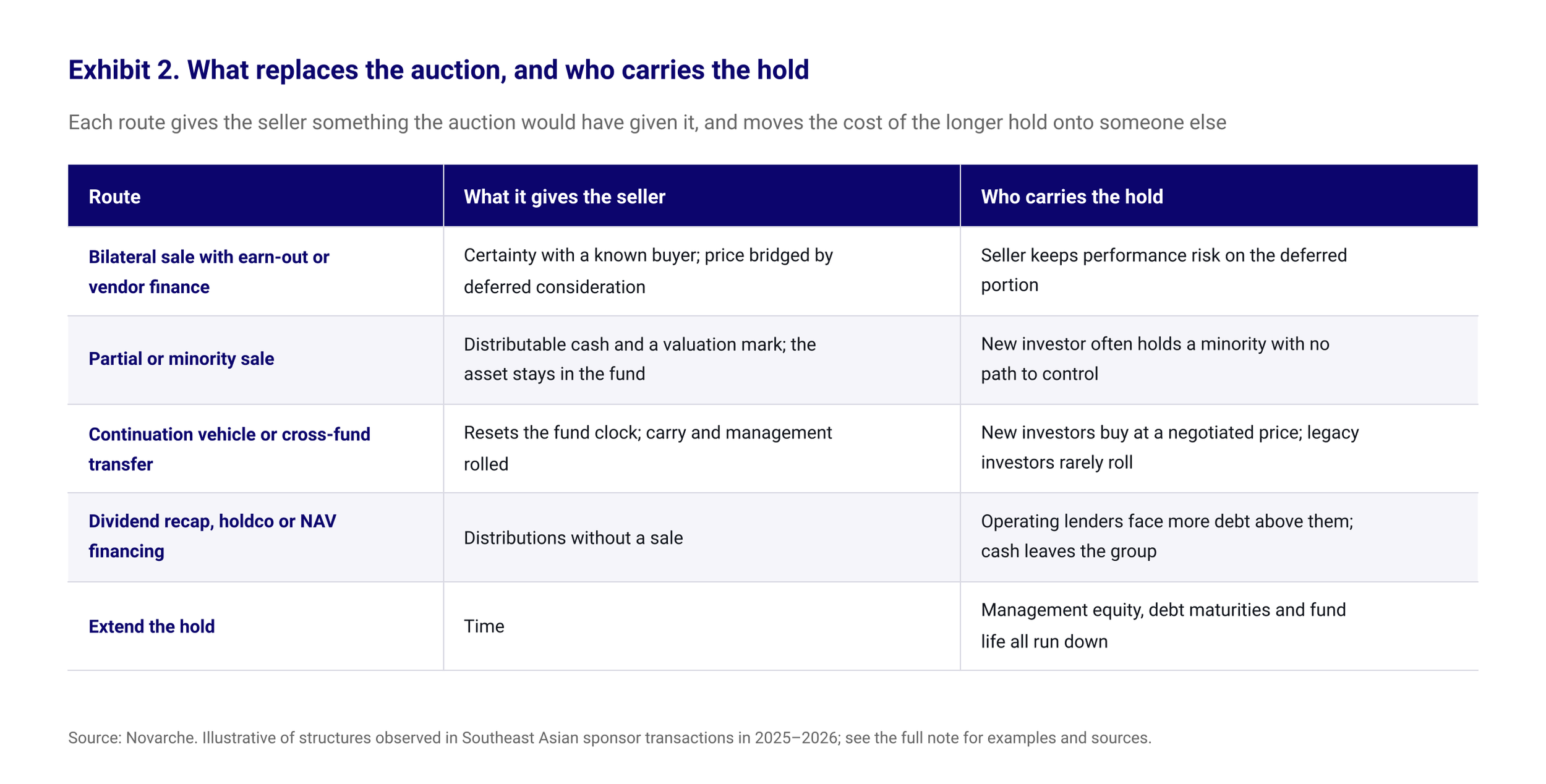
The structures follow. BizLink's agreement to acquire Blackstone's Interplex Datacom was priced at US$850m with up to US$50m of contingent consideration. Mekong Capital's third fund reaches the end of its term in May 2027 and is expected to sell its F88 stake before then at a price its chief executive has publicly called too low, through placements to a few new investors rather than a sale on the exchange. Navis closed a US$230m continuation vehicle for its education assets with TPG NewQuest as lead investor, and Navis and Dymon Asia are reported to be moving healthcare assets into newer funds.
Who Carries The Hold
The lender did not underwrite it. Acquisition debt is typically written for five to seven years against a case that assumes a sale in three to five, and globally the average hold at exit is now about seven years, so for a growing share of the book the maturity arrives before the exit. In our view the capital that finances the longer hold in Southeast Asia is more likely to come from the private credit funds now being raised in Singapore than from the NAV facilities used in the West, and where such funds lend at holding-company level the instrument sits above the operating-company debt and is serviced from the same cash flows. A lender in this region should underwrite the exit assumption explicitly, price a holding-company instrument for the subordination and cash leakage rather than accept the label "non-dilutive", and treat an amend-and-extend as something that should buy information rights and a fee.
Nor did the management team. In the typical structure, sweet equity sits beneath a preference that accrues at a fixed rate and ratchets are keyed to the sponsor's return. When the hold runs from four years to seven, the plan can move out of the money with no change in the company's results, and a continuation vehicle brings the question to a head because it crystallises the sponsor's position while asking management to carry on. Novarche's view is that a management plan should be re-underwritten at the point the hold passes its original case, not at the exit.
The Case Against, And What Remains
Exit value across Asia-Pacific rose a quarter last year, net distributions to limited partners turned positive after three years of outflows, and trade sales have long been the dominant route here. Asia is 4% to 5% of global secondary volume and Asian fund interests have priced at discounts of 35% or more, which argues that the substitutes have not yet arrived at scale. That narrows the claim without defeating it. Southeast Asia's realisations fell while the wider region's rose, sellers say the auction is not clearing, and the alternatives are being used first by the sponsors with the oldest assets and the shortest fund lives. The exit that is converted rather than completed does not remove risk from the system; it redistributes it, and the parties receiving it should price it as the new underwriting it is.