
The Capital That Cannot Land
Vietnam opened three doors to international finance this year: index reclassification, an international financial centre that licenses wholly foreign-owned banks, and a higher ownership ceiling for three lenders. Little of this reaches the banks that exist today: index money buys shares from their current holders, the centre licenses newly created institutions, and the higher ceiling is temporary, confined to three banks, and so far unused. Meanwhile the sector grew credit by 19% last year, and its largest additions to charter capital converted reserves into shares rather than bringing in new money.
September 2026 | Monthly Insights
Executive Summary
International capital has re-engaged with Vietnamese banking this year, even as portfolio investors remained net sellers of the wider equity market. BIDV completed a private placement of 258 million new shares in March and foreign investors took 116 million of them. VPBank has approval for a placement of 624.3 million new shares, Moody's raised the outlook on six banks to positive in May, and the FTSE Russell reclassification takes effect on 21 September.
The sector has earned much of this. Reported non-performing loans at listed banks stood at 2.01% at 30 June, against a system peak of 5.9% in September 2023 on the IMF staff measure, the four banks under mandatory transfer were absorbed across 2024 and 2025, and first-half profits grew at 23 of 27 banks. The difficulty lies elsewhere. Credit grew 19.0% in calendar 2025 and was still rising 18.1% year on year at the end of June. The largest completed capital increases at the state-owned banks over the same period were stock dividends, which convert reserves into shares and bring in no external capital.
Appetite is not the constraint. Strategic investors have paid premiums of 24% and 45% for stakes in Vietnamese banks. Every entry whose structure has been disclosed was a subscription for newly issued shares, so on our reading the ceiling limits how much external equity a bank can raise rather than how much foreigners may own, and index money draws on the same 30%. Novarche's view is that the ceiling should be lifted furthest where the capital need is greatest, and that the one exemption which does raise it has been built to expire.
1. The Capital Came Back
BIDV completed a private placement on 25 March, issuing 258 million new shares at VND38,900, with foreign investors allocated 116 million and foreign ownership rising from 17.1% to about 18.1%. VPBank's approved placement of 624.3 million shares, priced at no less than book value, would lift foreign ownership there to around 34%, which is open to it under the 49% exemption. Vietcombank's 6.5% sale has not been executed.
Reported discussions between Techcombank and both KB Kookmin and BNP Paribas over a stake of at least 15% at around US$2bn have been described as implying roughly two times book. No agreement has been announced, BNP Paribas denied any such plan on 27 August, and the structure was never disclosed, so this is market intelligence rather than a transaction.
The prices are public, and they show more than the headline consideration does.
Negotiated strategic stakes have cleared at substantial premiums: Mizuho paid about 24% above the market for 15% of Vietcombank in 2011, and SMBC about 45% above it for 15% of VPBank in 2023, close to twice book on our arithmetic. Placements marketed broadly to financial investors price at small discounts instead, as BIDV's did in 2026; its 2019 sale to KEB Hana, a negotiated stake at a 6% discount, is better explained by the bank's capital position than by anything structural. Appetite for Vietnamese bank equity at a premium is established. What is scarce is the room to sell it.
2. Three Doors
The first door is the index. FTSE Russell's reclassification takes effect on 21 September, with passive weight phased across four tranches to September 2027. Published estimates of the money involved differ by an order of magnitude and are broker forecasts. Index money buys existing shares from existing holders and does not reach a bank's balance sheet.
The second door is the International Financial Centre. Resolution 222/2025 took effect on 1 September 2025, establishing a single centre across Ho Chi Minh City and Da Nang, with eight implementing decrees in December. Members may settle in foreign currency and raise funds offshore without State approval. Decree 329/2025 licenses a wholly foreign-owned single-member commercial bank and a foreign bank branch into the centre: new institutions, not existing banks given a higher ceiling. Neither form is new to Vietnam, where ten wholly foreign-owned banks have been licensed since 2008; the terms of membership are.
The conditions are demanding. A parent must be rated AA- or Aa3 or better with at least a stable outlook, hold assets of at least US$10bn for a subsidiary or US$20bn for a branch, operate under a home-regulator supervisory arrangement with the State Bank, and commit in writing on capital and support. Speaking on 16 May, the vice chairman of the centre's Ho Chi Minh City executive board said more than ten international institutions had expressed interest but could not yet qualify, naming JPMorgan as clearing the rating and Bank of America, Bank of China and MUFG as falling short. No foreign bank has been licensed. In August the Government directed the State Bank to review those conditions, naming international investment banks, with the review due back in September.
The third door is Decree 69/2025, which allows foreign ownership of up to 49% at a commercial bank that received a compulsory transfer of a weak institution, provided the State does not hold more than half of it. Four transfers completed: CBBank to Vietcombank and OceanBank to MB in October 2024, DongA Bank to HDBank and GPBank to VPBank in January 2025. Vietcombank is excluded because the State holds about 75%, so three banks can use the cap. It also expires: the elevated ceiling runs only while the approved transfer plan is in force, and once it ends no further foreign purchases may be made until aggregate ownership falls back below 30%.
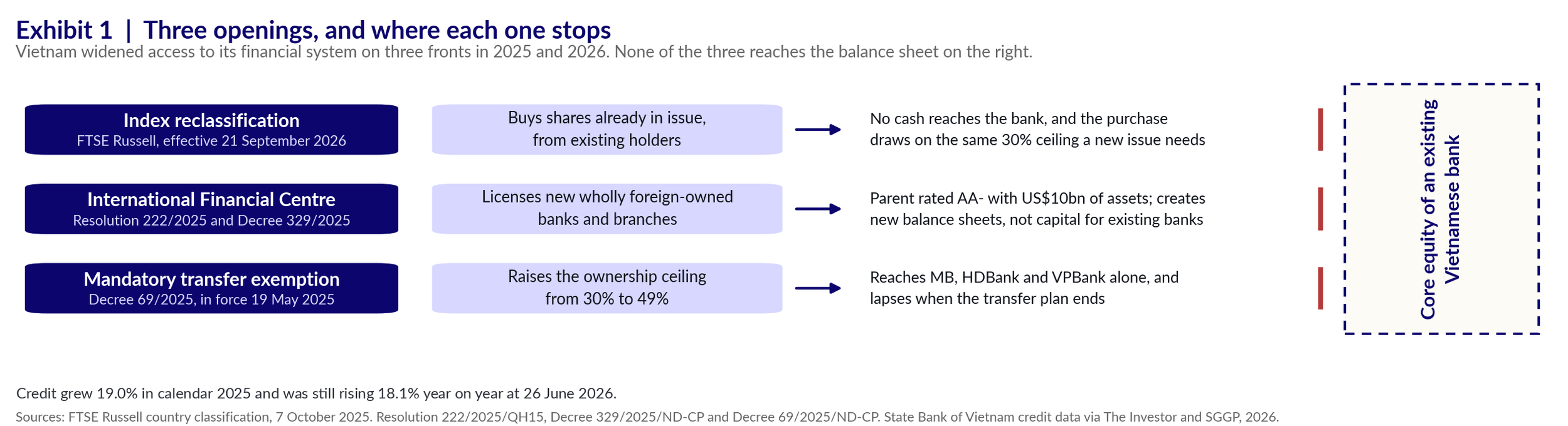
Vietnam's three openings of 2025 and 2026 — the FTSE index reclassification, the International Financial Centre and the mandatory-transfer exemption — each traced to where it stops short of the core equity of an existing Vietnamese bank.
Novarche's View
Each opening was designed for a different purpose and none was designed to recapitalise an existing Vietnamese bank. That the ceiling constrains capital raised rather than ownership held is our reading of an aggregate test rather than a rule stated in the decree; a bank at the ceiling can still raise domestic equity.
3. The Sector Was Rebuilt
The improvement in asset quality deserves to be stated at full strength before anything is made of the difficulties. Reported non-performing loans across listed banks stood at 2.01% at 30 June, against a system peak of 5.9% in September 2023, again on the IMF staff measure, and provision coverage at Vietcombank is 279%. The institutional repair matters more than the ratios. The four banks placed under mandatory transfer were absorbed across 2024 and 2025, and Law No. 96/2025 restored lenders' right, where the security contract provides for it, to enforce against collateral without a court process, whatever a loan's origination date. Pre-tax profit rose 33.5% at Vietcombank and 36.7% at VietinBank in the first half.
Two qualifications belong alongside this. The listed aggregate excludes Agribank, SCB and the four transferred banks; the IMF put the system figure at 5.3% in March 2025, and SCB remains unresolved almost four years on.
4. Novarche's View: The Sequence Is Wrong
Circular 14/2025 separated common equity tier one from total capital, with a fully loaded requirement of 10.5%. The measure that now matters is core equity, and this is where the arithmetic becomes difficult. The largest capital increases at the state-owned banks over the past two years were stock dividends: VND23.97tn at VietinBank and VND27.67tn at Vietcombank, with a further VND44.5tn at Vietcombank awaiting approval, while most of BIDV's approved VND21.66tn increase is dividend and reserve capitalisation rather than new money. A stock dividend brings in no external capital. It can raise recognised core capital where retained earnings carried a deduction for foreseeable distributions, but it adds nothing to the resources of the system.
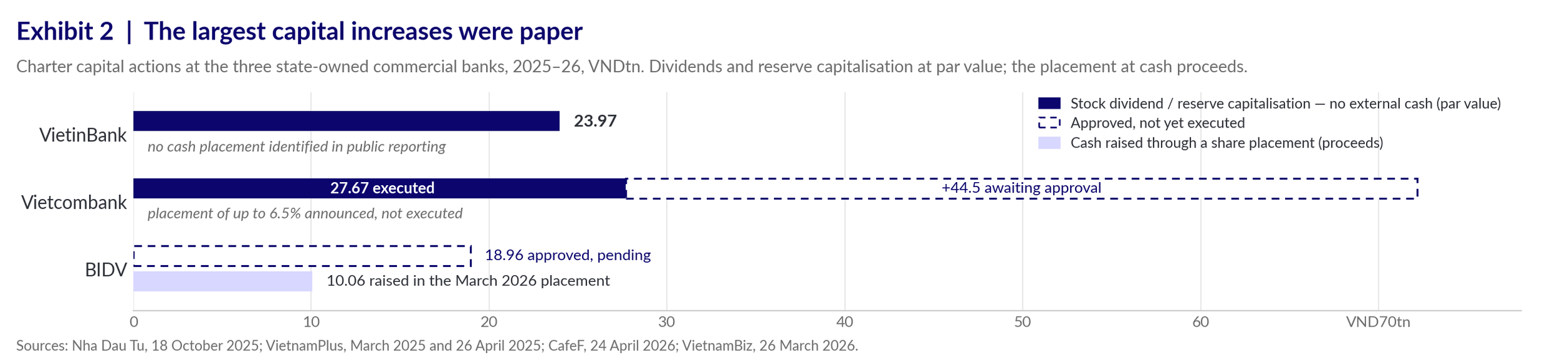
Charter capital actions at VietinBank, Vietcombank and BIDV in 2025–26: executed stock dividends of VND23.97tn and VND27.67tn, a further VND44.5tn awaiting approval, VND18.96tn approved but pending at BIDV, and the one completed external raising, BIDV's VND10.06tn placement of March 2026.
Retained earnings are the one channel that adds core capital from within, and three things are pressing on it at once. Twelve-month deposit rates at the four state-owned banks rose about 0.7 percentage points over the first half while medium and long-term lending held at 9% to 11%; margin, at 3.15% in the second quarter, recovered on the quarter but sat below a year earlier. Provision coverage has fallen to between 79% and 83% depending on the sample, while non-performing loans rose from 1.85% to 2.01% across the first half. Real estate business credit passed VND2,500tn at the end of June, up 12.7% in the quarter, while real estate developer bond coupons repriced from 8%-12% toward 12.5%-13.5%.
Four propositions follow, and we accept that each is contestable. The first is that the question of foreign control has long been settled. Vietnam has licensed wholly foreign-owned banks since 2008 and in December 2025 admitted the same form to the financial centre on freer terms. The 30% ceiling therefore protects the existing joint-stock banks from foreign capital rather than the country from foreign banking, and should be defended as that policy or removed.
The second is that the ceiling should be lifted asymmetrically, and the consequence accepted. The regime draws no distinction by size; the only elevated ceiling went to the three banks that absorbed a failure. We would introduce a distinction, permitting majority ownership below a defined systemic threshold and complete foreign ownership of a bank in resolution, while retaining 30% for the systemically important. This means foreign control of Vietnamese banks, which is the substance of the proposal rather than an unintended effect of it.
The third is that the eligibility test in the financial centre examines the wrong balance sheet. A parent rating measures the parent rather than the commitment, and as drafted it admits the institution with the least strategic need of Vietnam while excluding the Asian regional banks that have bought Vietnamese bank equity for fifteen years. The Government has ordered a review, which is welcome; the question is whether the test is relaxed or rebuilt around committed capital and a minimum holding period.
The fourth is that the one door which raises the ceiling was built to close. That makes it an inducement to absorb a failure rather than a liberalisation, asking a bank to take a distressed balance sheet in exchange for temporary access to capital. If 49% is prudentially acceptable at MB, HDBank and VPBank, it is acceptable permanently, and should be detached from the rescue that produced it.
The case against all of this is strong and should be recorded. Every bank in one broker's first-quarter sample cleared the fully loaded 10.5%, though that sample excludes BIDV, VietinBank and Sacombank, identified in domestic reporting as under capital pressure. The conservation buffer phases in over four years from each bank's adoption of Circular 14, and adoption is not mandatory before 2030, so the last adopters are not fully loaded until 2033. Decree 316/2026 doubles the share of profit state-participated banks may allocate to their development investment fund from 1 October, and Moody's is moving in the opposite direction to this note. Each point is correct, and none addresses the composition of the capital increase.
Conclusion
Nothing here is an argument about solvency. Vietnamese banks meet the requirement that applies to them today. The argument concerns capital formation: a system expanding credit at close to a fifth a year while its largest capital increases recompose capital that already exists rather than add to it. What would change the answer is a fourth door, opened deliberately and left open.